Parkinson’s Rehabilitation: Best Exercises to Improve Movement & Balance
Parkinson's disease is a progressive nervous disorder which impairs the motor system, causing tremors, rigidity, and a reduction in the speed of movement. Medication is usually an integral component of the management process, but clinical evidence indicates that without physical activity, one can lose independence. In particular, exercises for Parkinson’s patients may be used to manage the condition through facilitating neuroplasticity. This implies that the brain has the capacity to establish new connections to offset the damaged parts. A structured Parkinson’s rehab exercise routine may have potentially beneficial effects in slowing the decline of motor function.
What is the Role of Physiotherapy for Parkinson’s?
Physiotherapy is the keystone in the multidisciplinary management of neurological diseases. Physiotherapy is designed to enhance both the functionality and safety of patients in performing functional activities, particularly in cases of Parkinson's. The primary goal is to address the smallness of movement (bradykinesia), and it is also rigid. Movement therapy for Parkinson's assists a person in retraining the gait and posture through the use of certain clues and repetitive patterns.
- Amplitude Training: Considers large-scale exercises for Parkinson’s patients to oppose the reduction of movements to smaller and slower movements.
- Gait Training: Assists in minimising the possibility of the freezing phenomenon during gait.
- Postural Correction: Interventions to avoid the forward-bending position prevalent in later adulthood.
Statistically, it has been calculated that almost 70 per cent of persons with Parkinson’s disease fall once every year. Hence, balance exercises for Parkinson’s disease are an essential safety measure for the disease. These skills would be safe to exercise provided there is the required environment, which can be facilitated by professional guidance in the field of physiotherapy in Hyderabad.
Which Strength and Amplitude Exercises are Most Effective?
Development of muscle mass and retraining the brain's perception of movement. Core stability may be enhanced by regular exercises that Parkinson’s patients engage in, such as resistance exercises.
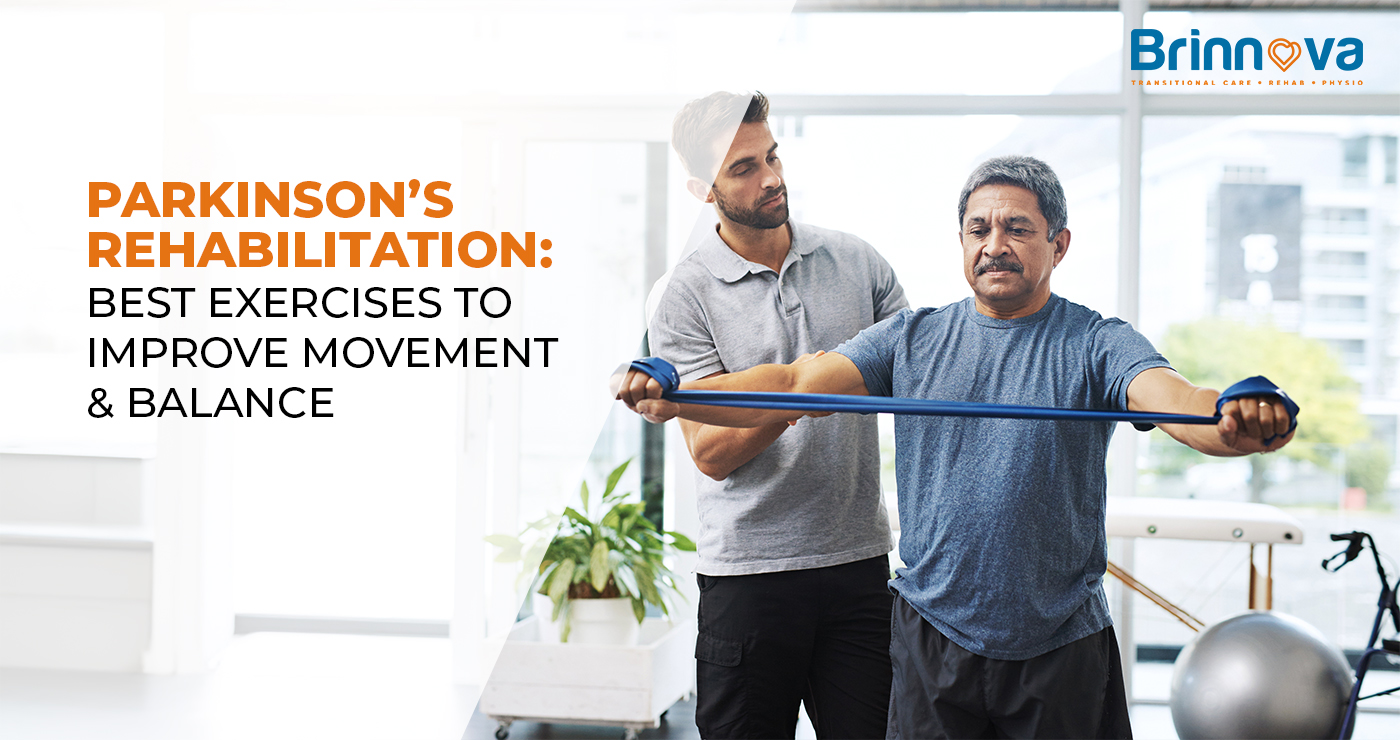
- Resistance Training: Making use of bands or light weights to make the lower limbs stronger, and they play a highly important role in keeping one in an erect position.
- LSVT BIG Protocol: It is a special intensive programme in which the patients do exaggerated physical movements. This assists in resetting the brain's perception of movement.
- Core Stabilisation: The process of making the abdominal and back muscles stronger to aid the spine and decrease rigidity.
Clinical studies have demonstrated that the use of Parkinson's rehab exercises, such as building up levels, has been shown to increase walking speed by up to 15%. This implies that intense movement can be effective compared to low-intensity stretching.
Why Focus on Balance and Coordination?
The centre of gravity tends to change as the disease advances, making it more unstable. Balance training in Parkinson's disease is aimed at pushing the sensory mechanisms that maintain balance to their limits.
- Tai Chi and Yoga: These methods involve weight-shifting and slow, controlled movement transitions, which are superb types of movement therapy in the case of Parkinson's.
- Dual-Task Training: Dual-task training involves combining physical activities, such as walking, with cognitive tasks, like counting backwards.
- Tandem Standing: Have them stand in a heel-to-toe position to make the base of support narrow and pose a challenge to the vestibular system.
Although they have been integrated into a regular physiotherapy routine, they enable the patients to enhance their reaction times. Evidence indicates that with routinely balanced training, the frequency of near-falls can be lowered by about 25-30 per cent among patients with neurological conditions.
How Do Aerobic and Functional Movements Help?
Aerobic exercise is believed to have a neuroprotective effect, which raises the concentration of brain-derived neurotrophic factor (BDNF). Access to specialised equipment will allow one to be safer during aerobic training, provided they want to obtain physiotherapy in Hyderabad.
- Stationary Cycling: This is a cardiovascular workout with a lower risk of falling than an outdoor bicycle ride.
- Nordic Walking: This involves the use of poles to engage the upper body and encourage arm swinging, which is an essential aspect of exercise for Parkinson's patients.
- Hydrotherapy: When exercises are done in water, they offer resistance, and the fear of falling is eliminated since the body is supported in the water, and therefore, the best exercises for Parkinson’s patients can be done.
According to the general clinical guidelines, 150 minutes of moderate-intensity aerobic exercise are recommended per week. This intensity is usually required in order to induce the chemical process in the brain that is involved in motor control.
What Should You Consider Before Starting a Program?
Physical activity is an excellent instrument which should be used sparingly since the physical condition of a patient with Parkinson's disease is delicate.
- Consistency: Movement therapy in the treatment of Parkinson's decreases rapidly when the regimen is discontinued.
- Safety First: Workouts should be done in an unhindered place, in a room or even on a chair or a railing to lean on.
- Professional Assessment: It is essential to involve a qualified physiotherapist experienced in treating Parkinson's to determine the appropriate intensity level.
Most centres specialising in physiotherapy in the city of Hyderabad tend to tailor such programmes based on advanced gait analysis. This will make sure that the team exercises patience with Parkinson's, focuses on particular deficiencies and does not simply use a general template.
Brinnova Care: A Partner in Neurological Recovery
To enhance mobility, a special setting and professional care are mandatory. At Brinnova Care, we aim for evidence-based exercises for Parkinson’s patients according to the stage of the illness. We offer an extensive range of physiotherapy for Parkinson's, including high-intensity workouts for patients with Parkinson's and state-of-the-art movement therapy for patients with Parkinson's.
We are the leaders in terms of physiotherapy in Hyderabad, which is why patient safety and functional independence are of primary importance. Our staff knows the peculiarities of balance training in the case of Parkinson's disease, which provides a conducive environment for long-term rehabilitation. Remember that, if you desire to have better movement or be better at moving, we are your guide to the enhanced movement you want to have.